Getting Started
Native ads let you design ad units that match the look and feel of your app's content.

Prerequisites
NAMSDK Import
Import the SDK module.
- Swift
- Objective-C
import GFPSDK
@import GFPSDK;
Initializing Native Ad Providers
With the Pod for the native ad provider you want to integrate added to your project, initialize via GFPAdManager. (Perform this only once when the app launches.)
| Provider Option | Ad Provider | CocoaPods |
|---|---|---|
| GFPNativeProviderOptionNDA | Naver NDA | pod 'GFPSDK/MediationNDA' |
| GFPNativeProviderOptionDFP | Google GAM (Google Ad Manager) | pod 'GFPSDKMediationDFP' |
| GFPNativeProviderOptionFAN | Meta Audience Network | pod 'GFPSDKMediationFAN' |
| GFPNativeProviderOptionInMobi | InMobi | pod 'GFPSDKMediationInMobi' |
| GFPNativeProviderOptionVungle | Liftoff (Vungle) | pod 'GFPSDKMediationVungle' |
| GFPNativeProviderOptionLAN | LINE Ads Network | pod 'GFPSDKMediationLAN' |
| GFPNativeProviderOptionBidMachine | BidMachine | pod 'GFPSDKMediationBidMachine' |
| GFPNativeProviderOptionPangle | Pangle | pod 'GFPSDKMediationPangle' |
- Swift
- Objective-C
// Add cocoapods dependencies if integrating DFP, NDA, Inmobi, or Facebook ads.
GFPAdManager.setup(withPublisherCd: "publisherCd") { (error : GFPError?) in
    print("Setup Eror: \(String(describing: error?.description))")
}
// Add cocoapods dependencies if integrating DFP, NDA, Inmobi, or Facebook ads.
[GFPAdManager setupWithPublisherCd:@"publisherCd" completionHandler:^(GFPError * _Nullable error) {
    NSLog(@"Setup ERROR: %@", error);
}];
For detailed GFPAdManager configuration, refer to Ad Manager Setup.
Writing the View Controller
Create a view controller (MyViewController) and perform the following in the header file (MyViewController.h).
(In this example, a single view controller implements all event protocols.)
- Declare a
GFPAdLoader *adLoaderproperty on the view controller. - Implement the
GFPAdLoaderDelegateprotocol on the view controller. - Declare a
GFPNativeAd *nativeAdproperty on the view controller. - Implement the
GFPNativeAdDelegateprotocol on the view controller.
GFPAdLoaderDelegatedelivers events related to native (and banner) ad loading, whileGFPNativeAdDelegatedelivers events such as impression, click, and rendering errors for the loaded native object.
- Swift
- Objective-C
// MyViewController.h
import GFPSDK

class MyViewController : UIViewController, GFPAdLoaderDelegate, GFPNativeAdDelegate {
    private var adLoader : GFPAdLoader?

    private var nativeAd : GFPNativeAd?
    private var nativeAdView : GFPNativeAdView?
}
// MyViewController.h

@import GFPSDK;

@interface MyViewController : UIViewController <GFPAdLoaderDelegate, GFPNativeAdDelegate>

@property (nonatomic) GFPAdLoader *adLoader;

@property (nonatomic) GFPNativeAd *nativeAd;
@property (nonatomic) GFPNativeAdView *nativeAdView;

@end
Creating GFPAdLoader and Requesting an Ad
In the viewDidLoad method of MyViewController.m, create an instance of GFPAdLoader and request an ad.
- When creating a
GFPAdLoaderinstance, provide your issued Ad Unit ID along with user information set in GFPAdParam.GFPAdParamis used for targeting to improve ad performance.
- Swift
- Objective-C
override func viewDidLoad() {
    super.viewDidLoad()

    let adParam = GFPAdParam()
    adParam.yearOfBirth = 1990
    adParam.gender = .male
    ...

    self.adLoader = GFPAdLoader(unitID: "UnitId", rootViewController: self, adParam: adParam)

    let nativeOption = GFPAdNativeOptions()
    nativeOption.renderingSetting = ... // Rendering settings for the native ad to be loaded
    self.adLoader?.setNativeDelegate(self, nativeOptions: nativeOption)

    self.adLoader?.delegate = self
    self.adLoader?.loadAd()
}
- (void)viewDidLoad {
    [super viewDidLoad];

    GFPAdParam *adParam = [[GFPAdParam alloc]init];
    adParam.yearOfBirth = 1990;
    adParam.gender = GFPAdParamGenderTypeMale;
    ...

    self.adLoader = [[GFPAdLoader alloc] initWithUnitID:self.unitID
                                             rootViewController:self
                                                        adParam:adParam];

    GFPAdNativeOptions *nativeOptions = [[GFPAdNativeOptions alloc] init];
    nativeOptions.renderingSetting = ...; // Rendering settings for the native ad to be loaded
    [self.adLoader setNativeDelegate:self nativeOptions:nativeOptions];

    // Request ad
    self.adLoader.delegate = self;
    [self.adLoader loadAd];
}
When an ad request succeeds, the adLoader:didReceiveNativeAd: method of GFPAdLoaderDelegate is called.
GFPAdLoaderDelegate
By implementing GFPAdLoaderDelegate, you can receive ad load-related events through the corresponding methods.
On Ad Load Success
When a native ad loads successfully, a GFPNativeAd object is returned as the response.
You use the GFPNativeAd object to create the native ad view (UIView).
For instructions on how to build a native ad view using the GFPNativeAd object, refer to the native ad view creation section.
- Swift
- Objective-C
func adLoader(_ unifiedAdLoader: GFPAdLoader!, didReceive nativeAd: GFPNativeAd!) {
      // Create ad view using the nativeAd object
      ...
}
- (void)adLoader:(GFPAdLoader *)unifiedAdLoader didReceiveNativeAd:(GFPNativeAd *)nativeAd {
      // Create ad view using the nativeAd object
      ...
}
On Ad Load Failure
- Swift
- Objective-C
func adLoader(_ unifiedAdLoader: GFPAdLoader!, didFailWithError error: GFPError!, responseInfo: GFPLoadResponseInfo!) {
    ...
}
- (void)adLoader:(GFPAdLoader *)unifiedAdLoader didFailWithError:(GFPError *)error responseInfo:(GFPLoadResponseInfo *)responseInfo {
    ...
}
Rendering Native Ads
Once GFPNativeAd has loaded successfully, you can render the native ad.
To do so, you need a view object that defines the elements of the native ad, and this object must subclass GFPNativeAdView.
In this document, Interface Builder is used to configure the view.
Creating the Native Ad View
-
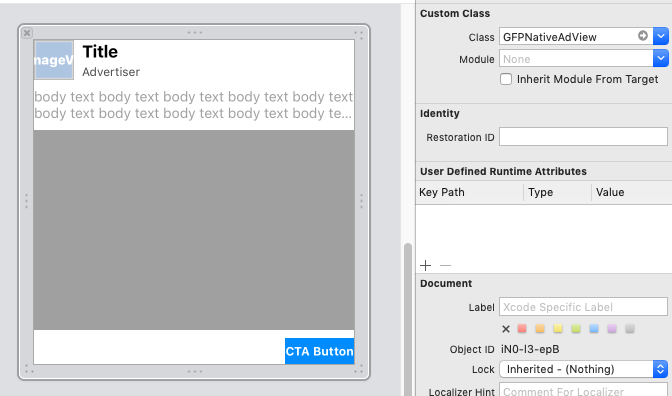
Create a view (xib) for the native ad and set the Custom Class to GFPNativeAdView in Xcode's Identity Inspector tab.
-
Create each asset view (title, body, etc.) that makes up the native ad view, and connect them to the corresponding outlets of
GFPNativeAdViewin the Connections Inspector tab.
- The
mediaViewused to display the ad's video or image must also have its Custom Class set to GFPMediaView.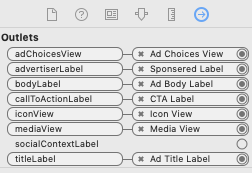
GFPNativeAdView IBOutlet List
| Outlet | Type | Description |
|---|---|---|
mediaView | GFPMediaView | Media view displaying the ad image or video |
iconView | UIImageView | Advertiser icon image |
titleLabel | UILabel | Ad title |
bodyLabel | UILabel | Ad body text |
advertiserLabel | UILabel | Advertiser name |
socialContextLabel | UILabel | Social context (e.g., "123 likes") |
callToActionLabel | UILabel | Call-to-action button label |
adChoicesView | UIView | AdChoices view (automatically inserted for DFP ads) |
adBadgeLabel | UILabel | "Ad" badge label |
noticeLabel | UILabel | Ad notice label |
serviceAdBadgeView | UIView | Service ad badge view |
socialContextLabel, adBadgeLabel, noticeLabel, and serviceAdBadgeView may not have values depending on the ad creative.
If additional labels are needed, you can register and retrieve them using the methods below.
- Swift
- Objective-C
// Register an additional label
nativeAdView.setExtraLabel(with: "custom_key", label: myLabel)

// Retrieve an additional label
let label = nativeAdView.extraLabel(with: "custom_key")
// Register an additional label
[nativeAdView setExtraLabelWith:@"custom_key" label:myLabel];

// Retrieve an additional label
UILabel *label = [nativeAdView extraLabelWith:@"custom_key"];
If additional image views are needed, you can register and retrieve them using the methods below.
- Swift
- Objective-C
// Register an additional image view
nativeAdView.setExtraImageView(with: "custom_key", imageView: myImageView)

// Retrieve an additional image view
let imageView = nativeAdView.extraImageView(with: "custom_key")
// Register an additional image view
[nativeAdView setExtraImageViewWith:@"custom_key" imageView:myImageView];

// Retrieve an additional image view
UIImageView *imageView = [nativeAdView extraImageViewWith:@"custom_key"];
- After loading the native ad, you can implement it in the following form.
- Swift
- Objective-C
func adLoader(_ unifiedAdLoader: GFPAdLoader!, didReceive nativeAd: GFPNativeAd!) {

    // Register native ad object and delegate
    self.nativeAd = nativeAd
    self.nativeAd?.delegate = self

    // Set native ad assets
    self.nativeAdView?.titleLabel?.text = nativeAd.title
    self.nativeAdView?.bodyLabel?.text = nativeAd.body
    self.nativeAdView?.advertiserLabel?.text = nativeAd.advertiser
    self.nativeAdView?.callToActionLabel?.text = nativeAd.callToAction
    ...

    // Assigning the native ad to the view object starts iconView/mediaView rendering and view tracking.
    self.nativeAdView?.nativeAd = nativeAd

    // Add as subview
    self.view.addSubview(self.nativeAdView!)
}
- (void)adLoader:(GFPAdLoader *)unifiedAdLoader didReceiveNativeAd:(GFPNativeAd *)nativeAd {

    // Register native ad object and delegate
    self.nativeAd = nativeAd;
    self.nativeAd.delegate = self;

    // Set native ad assets
    self.nativeAdView.titleLabel.text = nativeAd.title;
    self.nativeAdView.bodyLabel.text = nativeAd.body;
    self.nativeAdView.advertiserLabel.text = nativeAd.advertiser;
    self.nativeAdView.callToActionLabel.text = nativeAd.callToAction;
    ...

    // Assigning the native ad to the view object starts iconView/mediaView rendering and view tracking.
    self.nativeAdView.nativeAd = nativeAd;

    // Add as subview
    [self.view addSubview:self.nativeAdView]
}
GFPNativeAdDelegate
Events are delivered when the native ad is shown or clicked.
On Ad Impression
- Swift
- Objective-C
func nativeAdWasSeen(_ nativeAd: GFPNativeAd) {
    ...
}
- (void)nativeAdWasSeen:(GFPNativeAd *)nativeAd {
    ...
}
On Ad Rendered
- Swift
- Objective-C
func nativeAdWasRendered(_ nativeAd: GFPNativeAd) {
    ...
}
- (void)nativeAdWasRendered:(GFPNativeAd *)nativeAd {
    ...
}
On Click
- Swift
- Objective-C
func nativeAdWasClicked(_ nativeAd: GFPNativeAd) {
    ...
}
- (void)nativeAdWasClicked:(GFPNativeAd *)nativeAd {
    ...
}
On Rendering Error
- Swift
- Objective-C
func nativeAd(_ nativeAd: GFPNativeAd, didFailWithError error: GFPError) {
    ...
}
- (void)nativeAd:(GFPNativeAd *)nativeAd didFailWithError:(GFPError *)error {
    ...
}
When the Ad is Muted by the User
When an ad is muted, a callback notifies the service of the mute action. After muting, NAMSDK displays a screen saying "This ad will no longer be shown." Whether to remove the ad from the screen or continue displaying it is determined by the service's own policy.
- Swift
- Objective-C
func nativeAdWasMuted(_ nativeAd: GFPNativeAd) {

}
- (void)nativeAdWasMuted:(GFPNativeAd *)nativeAd {

}
On Mute Cancelled
- Swift
- Objective-C
func nativeAdWasCanceledMute(_ nativeAd: GFPNativeAd) {

}
- (void)nativeAdWasCanceledMute:(GFPNativeAd *)nativeAd {

}
In-App Browser Presented / Dismissed Events
Called when the default in-app browser is presented or dismissed after an ad click.
- Swift
- Objective-C
func nativeAdDidPresentDefaultInAppBrowser(_ nativeAd: GFPNativeAd) {
    // In-app browser presented
}

func nativeAdDidDismissDefaultInAppBrowser(_ nativeAd: GFPNativeAd) {
    // In-app browser dismissed
}
- (void)nativeAdDidPresentDefaultInAppBrowser:(GFPNativeAd *)nativeAd {
    // In-app browser presented
}

- (void)nativeAdDidDismissDefaultInAppBrowser:(GFPNativeAd *)nativeAd {
    // In-app browser dismissed
}
Resource Reload Events
Called when an ad resource reload succeeds or fails at the point a reload is needed.
- Swift
- Objective-C
func nativeAdDidReloaded(_ nativeAd: GFPNativeAd) {
    // Reload succeeded
}

func nativeAd(_ nativeAd: GFPNativeAd, didReloadFailWithError error: GFPError) {
    // Reload failed
}
- (void)nativeAdDidReloaded:(GFPNativeAd *)nativeAd {
    // Reload succeeded
}

- (void)nativeAd:(GFPNativeAd *)nativeAd didReloadFailWithError:(GFPError *)error {
    // Reload failed
}
userInterestDelegate
Setting GFPNativeAd.userInterestDelegate lets you receive notifications when the user's interest in the ad changes.
- Swift
- Objective-C
self.nativeAd?.userInterestDelegate = self

// GFPUserInterestDelegate
func ad(_ ad: NSObject, didChangeUserInterest userInterest: Bool) {
    // userInterest: whether the user is showing interest in the ad
}
self.nativeAd.userInterestDelegate = self;

// GFPUserInterestDelegate
- (void)ad:(NSObject *)ad didChangeUserInterest:(BOOL)userInterest {
    // userInterest: whether the user is showing interest in the ad
}
Other
Rendering Native Ads Using the Ad Provider's Native Ad Object Directly
The GFPNativeAd object holds the original native object obtained from the native ad provider, accessible via the adProviderNativeAd field of the GFPNativeAd object.
Additionally, the adProviderType of the GFPNativeAd object identifies which ad provider the currently loaded native ad belongs to. By upcasting the adProviderNativeAd object to the corresponding provider's native type based on adProviderType, you can access each ad provider's original native object.
Finally, using this original native object, you build the native ad view according to each ad provider's guide.
- Swift
- Objective-C
import FBAudienceNetwork    // FAN SDK
import GoogleMobileAds      // DFP SDK

func adLoader(_ unifiedAdLoader: GFPAdLoader!, didReceive nativeAd: GFPNativeAd!) {

    // Register native ad object and delegate
    self.nativeAd = nativeAd
    self.nativeAd?.delegate = self

    if nativeAd.adProviderType == .FAN {
        // FAN native ad case
        ...
    } else if nativeAd.adProviderType == .DFP {
        // DFP native ad case
        ...
    }
}
@import FBAudienceNetwork;    // FAN SDK
@import GoogleMobileAds;      // DFP SDK

- (void)adLoader:(GFPAdLoader *)unifiedAdLoader didReceiveNativeAd:(GFPNativeAd *)nativeAd {

    // Register native ad object and delegate
    self.nativeAd = nativeAd;
    self.nativeAd.delegate = self;

    if (_nativeAd.adProviderType == GFPNativeAdProviderTypeFAN) {
        // FAN native ad case
        ...


    } else if (gfpNativeAd.adProviderType == GFPNativeAdProviderTypeDFP) {
        // DFP native ad case
        ...
    }

}
Native Ad Implementation Guides by Provider
Ad Invalidation Check
Native ads have an expiration time, so when displaying preloaded and cached ads, you must use the isAdInvalidate method to check whether the ad has expired. Displaying an expired ad will not earn you any compensation for the impression.
- Swift
- Objective-C
func adLoader(_ unifiedAdLoader: GFPAdLoader!, didReceive nativeAd: GFPNativeAd!) {

    // Register native ad object and delegate
    self.nativeAd = nativeAd
    self.nativeAd?.delegate = self

    // Check if ad is already expired or invalidated, and do not show ad if that is the case.
    // You will not get paid to show an invalidated ad.
    if nativeAd.isAdInvalidate {
        print("This ad has been invalidated. Try again!")
        return
    }
}
- (void)adLoader:(GFPAdLoader *)unifiedAdLoader didReceiveNativeAd:(GFPNativeAd *)nativeAd {

    // Register native ad object and delegate
    self.nativeAd = nativeAd;
    self.nativeAd.delegate = self;

    // Check if ad is already expired or invalidated, and do not show ad if that is the case.
    // You will not get paid to show an invalidated ad.
    if (nativeAd.isAdInvalidate) {
        NSLog(@"This ad has been invalidated. Try again!");
        return;
    }
}